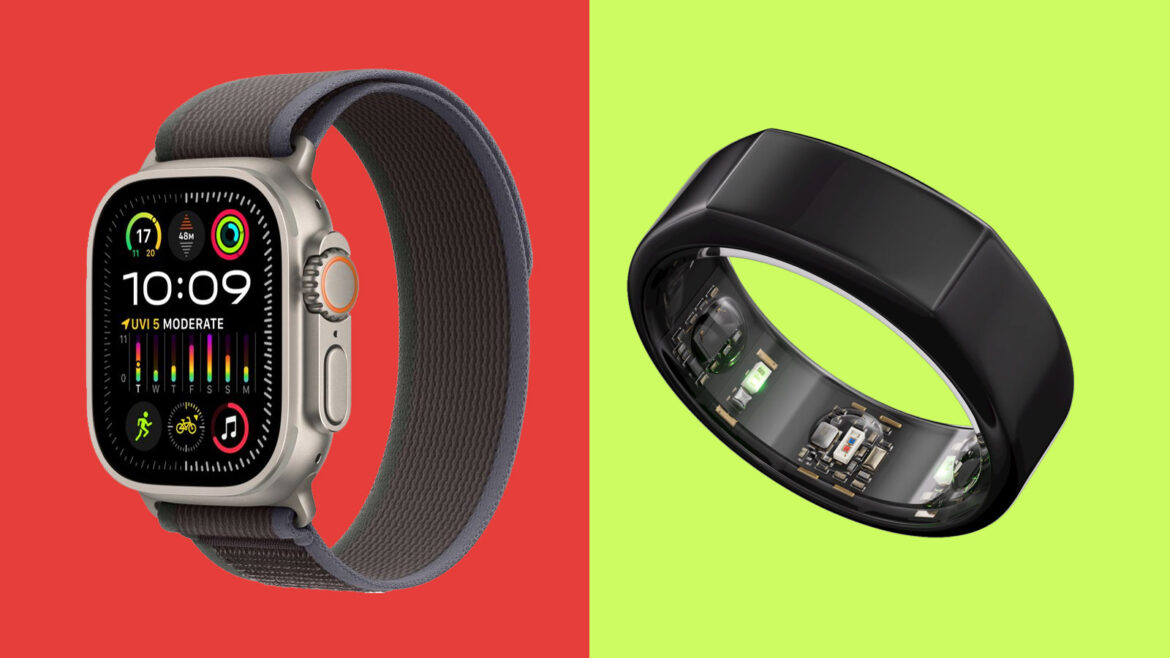
Smart rings and smartwatches collect some of the same information, but they provide very different experiences. A smart ring emphasizes discreet, passive tracking. A smartwatch adds a screen, notifications, navigation, workout tools, and other features that can reduce how often you reach for your phone.
The right choice depends less on which category is more advanced and more on what you expect the wearable to do every day.
Smart Rings vs. Smartwatches at a Glance
| Feature | Smart Ring | Smartwatch |
|---|---|---|
| Design | Small and discreet | Larger device with a display |
| Battery life | Often several days | Ranges from roughly one day to several weeks |
| Sleep tracking | Usually comfortable overnight | Useful, but some models feel bulky in bed |
| Notifications | Usually viewed through a phone app | Displayed directly on the wrist |
| Workout tracking | Suitable for basic activity and recovery | Better for live workout data and GPS |
| Calls and messages | Not normally supported | Supported on many models |
| Charging | Usually every five to nine days | Varies considerably by brand and features |
| Ideal user | Someone focused on sleep and passive wellness tracking | Someone wanting fitness tools and smartphone features |
What Is a Smart Ring?
A smart ring places miniature sensors inside a ring-shaped wearable. Depending on the model, these sensors can collect information about movement, heart rate, heart-rate variability, skin temperature, sleep, and recovery.
Because a smart ring has no conventional screen, most information is reviewed through a companion smartphone application. This makes the ring less distracting than a smartwatch. There are no social media notifications appearing on your finger, and there is less temptation to interact with it throughout the day.
The absence of a display also helps conserve power. For example, the Oura Ring 5 is rated for up to nine days of battery life, although actual results depend on settings and usage. The Samsung Galaxy Ring can last up to seven days, with battery capacity varying by ring size.
What Is a Smartwatch?
A smartwatch combines health and activity sensors with a small interactive display. In addition to recording fitness information, it may display messages, provide turn-by-turn navigation, control music, make contactless payments, run applications, and handle calls.
Current models range from general-purpose devices such as the Apple Watch Series 11 to fitness-focused watches such as the Garmin Venu 4.
Apple rates the Series 11 for up to 24 hours of normal use, while the 45mm Garmin Venu 4 is rated for up to 12 days in smartwatch mode. These estimates demonstrate why it is important to compare individual watches rather than assuming every smartwatch requires daily charging.
Where Smart Rings Have the Advantage
Comfortable sleep tracking
A ring is generally less noticeable in bed than a large watch. This can make smart rings particularly attractive to people interested in sleep duration, sleep patterns, overnight heart rate, and recovery trends.
The Oura platform, for example, organizes collected information into Sleep, Activity, and Readiness scores. Samsung presents Galaxy Ring information through the Samsung Health application, including sleep and energy-related insights.
Longer battery life
Most smart rings do not power a bright display or continuously show notifications. As a result, they can usually operate for several days between charges.
Long battery life matters because a wearable cannot record sleep or activity while sitting on its charger. Someone who regularly forgets to charge electronics may find a ring easier to maintain.
A discreet appearance
Smart rings resemble ordinary jewelry more closely than fitness equipment. They work well for people who want health information without wearing a screen on their wrist or replacing a traditional watch.
Fewer distractions
A ring collects information quietly. For someone trying to reduce screen time, that simplicity is an advantage rather than a limitation.
Where Smartwatches Have the Advantage
Live workout information
Runners, cyclists, hikers, and gym users may want to see distance, pace, elapsed time, heart-rate zones, or navigation instructions during an activity. A smartwatch can display this information immediately, while a smart ring generally requires checking a phone afterward.
Many sports watches also include built-in GPS. That makes them better suited to tracking outdoor routes without relying entirely on a nearby smartphone.
Notifications and communication
A smartwatch can show incoming calls, calendar reminders, messages, alarms, and application alerts. Some cellular models can remain connected even when the wearer leaves a phone at home, although cellular service normally requires a compatible mobile plan.
Apps and contactless payments
Depending on the brand, a smartwatch may support mobile payments, music playback, maps, weather forecasts, timers, voice assistants, and third-party applications. A smart ring cannot provide the same level of interaction without a screen.
More detailed fitness features
A ring can identify movement and certain workouts, but serious athletes usually receive more actionable information from a sports watch. Garmin devices, for example, are designed around structured workouts, GPS activity recording, and performance metrics in addition to general wellness monitoring.
Smart Ring Models Worth Considering
Oura Ring 5
The Oura Ring 5 is designed around sleep, activity, stress, heart-health information, and recovery. Its smaller titanium design and advertised battery life of up to nine days make it attractive to someone who wants a discreet, cross-platform wearable.
The Oura application supports compatible iPhones and Android phones. However, access to Oura’s complete insights requires a membership, currently priced at $5.99 per month or $69.99 annually in the United States. Regional pricing may differ.
Recommended for: People who prioritize sleep, recovery, and a polished wellness application.
Samsung Galaxy Ring
The Samsung Galaxy Ring uses an accelerometer, optical biosignal sensor, and skin-temperature sensor to support activity and wellness tracking.
It works with compatible Android phones running Android 11 or later, although certain AI features require a Galaxy smartphone and Samsung account. This makes it especially appealing to people already using Samsung phones, Galaxy Watches, and Samsung Health.
Recommended for: Android and Samsung Galaxy users who want passive health tracking within the Samsung ecosystem.
Smartwatch Models Worth Considering
Apple Watch Series 11
The Apple Watch Series 11 combines activity tracking with notifications, applications, music controls, safety features, and deep iPhone integration.
Its major limitation is platform compatibility: Apple Watch is designed for iPhone users. Its advertised 24-hour battery life is also shorter than the endurance offered by most smart rings and many Garmin watches.
Recommended for: iPhone owners who want a full-featured wearable rather than a passive tracker.
Garmin Venu 4
The Garmin Venu 4 is a fitness and health smartwatch featuring a bright display, multi-band GPS, 24-hour health monitoring, and an LED flashlight.
The 45mm model offers up to 12 days of advertised battery life in smartwatch mode, although GPS, music, display settings, and other features will affect real-world endurance.
Recommended for: Active users who want longer battery life, GPS, and detailed workout tracking.
Important Questions to Ask Before Buying
Which phone does the recipient use?
Compatibility should be the first consideration. Apple Watch requires an iPhone, while the Galaxy Ring requires a compatible Android phone. Oura and many Garmin devices support both major mobile platforms, but operating-system requirements still apply.
Will the device be worn while sleeping?
If sleep tracking is the main objective, a smart ring may be more comfortable. However, people who do not normally wear rings may prefer a lightweight watch.
Does the recipient want notifications?
Choose a smartwatch if the wearer wants messages, calls, navigation, alarms, or music controls on the wrist. Choose a ring if the objective is to collect information quietly.
Is there an ongoing subscription?
Always calculate the long-term cost. Some wearables provide their complete experience after the initial purchase, while others place detailed analysis behind a monthly or annual membership.
Is the size correct?
Smart-ring sizing is especially important. Fingers can change size during the day, in hot weather, and during exercise. Use the manufacturer’s official sizing kit before ordering rather than relying on an ordinary jewelry-ring measurement.
Can You Wear a Smart Ring and Smartwatch Together?
Yes. A ring can handle overnight and passive wellness tracking, while a watch provides GPS, notifications, and live workout information. Samsung specifically supports using its Galaxy Ring alongside a Galaxy Watch.
However, wearing both devices may produce overlapping information, and buying two premium wearables is unnecessary for most people. Start with the device that addresses the main requirement and add another only if a clear gap remains.
Final Verdict
Choose a smart ring if you value comfort, longer battery life, discreet design, sleep tracking, and minimal distraction. The Oura Ring 5 offers a mature cross-platform experience, while the Galaxy Ring is particularly attractive within Samsung’s ecosystem.
Choose a smartwatch if you want live workout statistics, GPS, calls, notifications, payments, music controls, and applications. Apple Watch is the natural option for iPhone owners, while Garmin offers compelling fitness tools and longer battery life.
Neither wearable category is universally superior. The better purchase is the one the recipient will wear consistently. A sophisticated device left on a bedside table collects no useful information at all.
Health and wellness wearables are not substitutes for professional medical evaluation. Features and regulatory availability vary by model, country, and software version.